

 Posted by
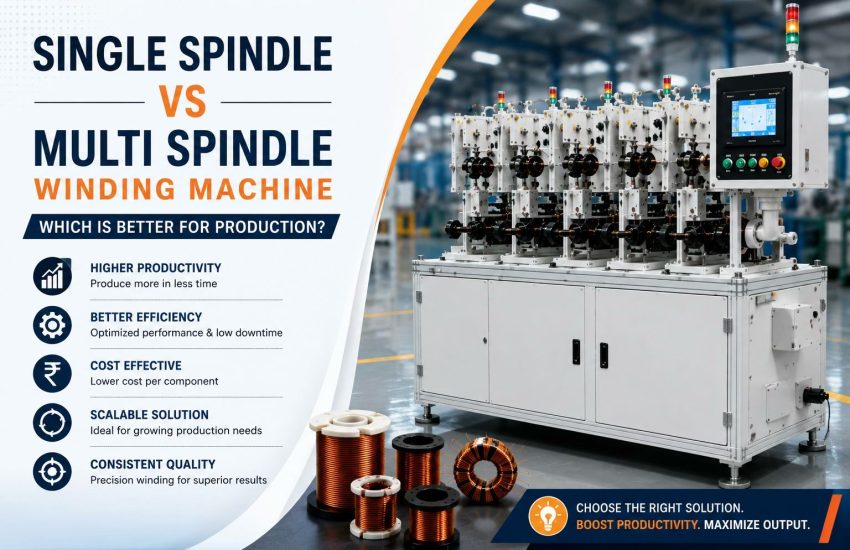
 Manufacturers working with coils, transformers, motors, inductors, and other electrical components often need to choose the right winding configuration for their production requirements. Two commonly considered options are Single Spindle Winding Machines and Multi Spindle Winding Machines.
The choice between a Single Spindle vs Multi Spindle Winding Machine can affect production speed, labor requirements, machine utilization, flexibility, and overall manufacturing costs.
While a single-spindle machine can be an excellent choice for flexible or lower-volume production, multi-spindle equipment can significantly increase output when manufacturers need to produce large quantities of similar components.
At ACME Mechatronics, winding solutions are designed to help manufacturers achieve consistent winding quality while selecting equipment that matches their specific production objectives.
What Is a Single Spindle Winding Machine?
A Single Spindle Winding Machine uses one spindle to wind wire onto a component or core. It is commonly used for applications where manufacturers require flexibility, product variation, or moderate production volumes.
Because the machine focuses on one winding operation at a time, operators can easily monitor the process and make adjustments when required.
Benefits of Single Spindle Winding Machines
- Simple operation
- Flexible for different products
- Easier product changeovers
- Lower initial investment
- Suitable for low-to-medium production volumes
- Easier setup and maintenance
- Good option for customized production
A single-spindle configuration can be particularly useful when manufacturers produce several different products rather than extremely large quantities of one product.
What Is a Multi Spindle Winding Machine?
A Multi Spindle Winding Machine uses multiple spindles to perform winding operations simultaneously or in a coordinated production process.
This configuration is designed primarily to increase manufacturing throughput. Instead of processing one component at a time, manufacturers can produce multiple components during the same production cycle.
Benefits of Multi Spindle Winding Machines
- Higher production output
- Better machine utilization
- Reduced production cycle time
- Lower labor requirements per component
- Suitable for high-volume manufacturing
- Consistent production quality
- Excellent automation potential
For manufacturers with large and predictable production orders, multi-spindle equipment can provide significant productivity advantages.
Single Spindle vs Multi Spindle Winding Machine
| Feature | Single Spindle | Multi Spindle |
| Production Volume | Low to medium | Medium to high |
| Output | Standard | High |
| Flexibility | Excellent | Moderate |
| Product Changeover | Easier | More complex |
| Initial Investment | Lower | Higher |
| Automation | Available | Excellent |
| Labor Efficiency | Good | Very high |
| Best For | Diverse products | High-volume production |
Which Machine Offers Better Productivity?
When comparing Single Spindle vs Multi Spindle Winding Machine, production volume is one of the most important considerations.
A single-spindle machine may provide better flexibility when manufacturers frequently switch between different products. However, a multi-spindle machine can significantly increase output when the same or similar components are produced continuously.
For example, a manufacturer producing thousands of identical coils may benefit from a multi-spindle configuration because multiple winding operations can be completed within a shorter production period.
Cost Considerations
The initial cost of a multi-spindle machine is generally higher because it incorporates additional spindles, controls, tooling, and automation.
However, manufacturers should evaluate total cost of ownership rather than looking only at the purchase price.
A multi-spindle machine may reduce:
- Labor costs
- Production cycle times
- Cost per component
- Manufacturing bottlenecks
- Equipment downtime
A single-spindle machine, meanwhile, may provide better value for manufacturers with lower production volumes or frequent product changes.
Which Machine Should You Choose?
Choose a Single Spindle Winding Machine if:
- Your production volume is relatively low or moderate.
- You manufacture multiple product types.
- Product changeovers are frequent.
- Flexibility is more important than maximum output.
- You want a lower initial investment.
Choose a Multi Spindle Winding Machine if:
- You have high-volume production requirements.
- You manufacture standardized components.
- Faster production is a priority.
- You want to reduce labor costs.
- Consistent high-volume output is required.
ACME Mechatronics can help manufacturers evaluate their production requirements and determine which winding configuration provides the best balance of flexibility, productivity, and investment.
Applications
Single and multi-spindle winding systems can be used across several industries, including:
- Transformer manufacturing
- Electric motor production
- Automotive components
- Power electronics
- Industrial equipment
- Renewable energy systems
- Telecommunications
- Electrical component manufacturing
The ideal configuration depends on the specific component, wire characteristics, winding pattern, production volume, and automation requirements.
Why Choose ACME Mechatronics?
Choosing the right Industrial Winding Equipment requires more than simply selecting a machine based on spindle count.
ACME Mechatronics focuses on developing precision winding solutions that address real manufacturing requirements. From standard equipment to specialized winding systems, the company provides solutions designed to improve production efficiency and winding consistency.
Manufacturers can benefit from:
- Precision-engineered winding equipment
- Automated production solutions
- Application-focused machine design
- Technical support
- Customized manufacturing solutions
- Long-term equipment reliability
Conclusion
The decision between a Single Spindle vs Multi Spindle Winding Machine ultimately depends on your production requirements.
A single-spindle machine is generally better suited to manufacturers who prioritize flexibility, product variety, and manageable production volumes. A multi-spindle machine is more suitable for high-volume production where output, consistency, and productivity are critical.
Before making a purchase, manufacturers should consider production volume, product variation, automation requirements, labor costs, and future expansion.
With the right winding equipment from an experienced manufacturer such as ACME Mechatronics, businesses can improve production efficiency while maintaining the precision and consistency required for modern electrical component manufacturing.
Frequently Asked Questions
1. What is the main difference between single-spindle and multi-spindle winding machines?
A single-spindle machine performs winding using one spindle, while a multi-spindle machine uses multiple spindles to increase production capacity and output.
2. Which winding machine is better for high-volume production?
A Multi Spindle Winding Machine is generally better for high-volume production because it can increase output and reduce production cycle times.
3. Is a Single Spindle Winding Machine more flexible?
Yes. Single-spindle machines are generally easier to configure for different products and frequent changeovers.
4. Are Multi Spindle Winding Machines more expensive?
They typically require a higher initial investment, but the increased production capacity can provide better long-term cost efficiency for high-volume manufacturing.
5. How do I choose the right winding machine?
Consider production volume, product variety, winding specifications, automation requirements, labor costs, and future production plans.
6. Can ACME Mechatronics provide customized winding solutions?
Yes. ACME Mechatronics provides winding solutions that can be tailored to specific production and application requirements.