

 Posted by
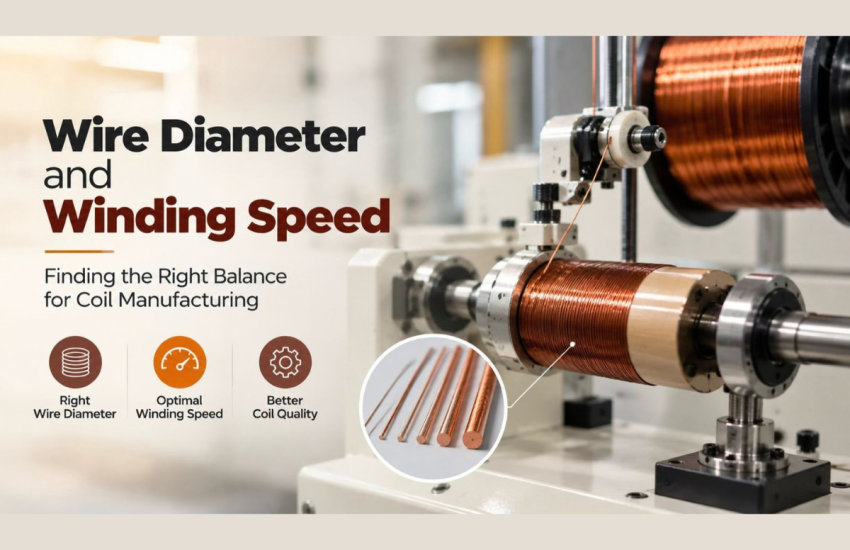
 In coil manufacturing, two important parameters that need careful consideration are winding speed and wire diameter. Manufacturers may want to increase production speed to improve output, but the appropriate winding speed depends significantly on the characteristics of the wire and the design of the finished coil.
Using a winding speed that is too high for a particular wire can increase the risk of wire breakage, insulation damage, inconsistent winding, and production defects. On the other hand, operating unnecessarily slowly may reduce productivity.
Finding the right relationship between winding speed and wire diameter is therefore essential for achieving an efficient and controlled winding process.
Why Wire Diameter Matters in Coil Winding
Wire diameter influences how the wire behaves during the winding process.
Fine wire is generally more sensitive to mechanical stresses and handling conditions. Larger wire, meanwhile, may require different feeding, tension, and positioning parameters.
When selecting winding parameters, manufacturers may need to consider:
- Wire diameter
- Wire material
- Insulation type
- Coil dimensions
- Required number of turns
- Winding pattern
- Spool size
- Machine configuration
- Required production output
These variables should be considered together rather than setting winding speed independently.
Understanding the Relationship Between Winding Speed and Wire Diameter
The relationship between winding speed and wire diameter is important because the wire must be transported and positioned accurately while the winding operation takes place.
When winding speed increases, the wire-handling system must maintain stable movement and appropriate tension. If the system cannot maintain the required control, the increased speed may affect winding quality.
For example, fine wire may require careful control of acceleration, tension, and guiding because excessive mechanical stress can damage the conductor or its insulation.
Larger wire can have different handling characteristics and may require different machine settings.
Therefore, there is no universal winding speed that works for every wire diameter.
What Happens When Winding Speed Is Too High?
Increasing winding speed can improve production output, but excessive speed can introduce manufacturing challenges.
Potential issues include:
Wire Breakage
If mechanical stress exceeds the wire’s tolerance, the conductor may break during winding.
Insulation Damage
The insulating coating can be affected by excessive tension, friction, or uncontrolled movement.
Uneven Wire Placement
At inappropriate speeds, the wire may not follow the required winding path accurately.
Coil Deformation
Incorrect speed combined with unsuitable tension can affect the physical shape of the finished coil.
Increased Rejection
Quality problems can lead to additional inspection, rework, or rejected components.
For this reason, simply increasing machine speed is not always the best way to improve production.
What Happens When Winding Speed Is Too Low?
Operating at a lower speed can provide greater process control in some applications, but it may also reduce production efficiency.
A manufacturer producing large quantities of standardized coils may find that unnecessarily low winding speeds increase cycle time and reduce available production capacity.
The objective should therefore be to identify a suitable operating range that provides both winding quality and production efficiency.
The Role of Wire Tension
Wire tension is closely connected to winding speed and wire diameter.
As winding speed changes, the wire-handling system needs to maintain appropriate tension throughout the process.
Stable tension can help the wire remain properly positioned while reducing the risk of:
- Wire stretching
- Wire breakage
- Loose winding
- Uneven layers
- Insulation damage
- Inconsistent coil dimensions
The correct tension setting will depend on the wire and application.
How Machine Control Helps Manage Winding Parameters
Modern winding equipment can provide programmable control over important production parameters.
Depending on the machine design, manufacturers may be able to control:
- Winding speed
- Number of turns
- Rotation direction
- Traverse movement
- Acceleration and deceleration
- Wire tension
- Coil dimensions
- Winding sequences
These controls can help manufacturers establish repeatable production conditions for specific coil designs.
Choosing the Right Winding Speed for Different Wire Sizes
Instead of using a fixed approach, manufacturers should evaluate the complete application.
Fine Wire
Fine wire generally requires careful handling. Controlled acceleration, stable tension, and suitable guiding can be important when working with smaller wire diameters.
Medium-Diameter Wire
Medium wire sizes may allow greater flexibility in operating parameters, depending on the material, insulation, coil configuration, and machine.
Larger Wire
Larger conductors can require different feeding and handling characteristics. Machine capability and tooling should be considered before increasing production speed.
The exact operating parameters should always be established through the machine manufacturer’s specifications and application testing.
How to Improve Coil Production Efficiency
Manufacturers looking to improve productivity should consider the complete winding process rather than focusing only on speed.
Useful areas to evaluate include:
- Machine setup
- Wire tension
- Wire guidance
- Spool handling
- Tooling
- Acceleration settings
- Winding pattern
- Operator workflow
- Inspection procedures
A well-controlled process can allow manufacturers to improve productivity without unnecessarily increasing defect rates.
Why Precision Matters in Coil Manufacturing
Coils are used in many electrical and electronic products where dimensional and electrical consistency can be important.
A small variation in winding can influence the final component’s characteristics. Maintaining control over winding speed and wire diameter helps manufacturers establish production conditions appropriate for the component being manufactured.
Precision is especially important when working with fine wires, compact components, and complex winding patterns.
ACME Mechatronics: Winding Solutions for Industrial Applications
ACME Mechatronics provides coil winding machines and customized winding solutions for a wide range of electrical and industrial applications.
When selecting winding equipment, manufacturers can evaluate requirements such as wire diameter, coil size, winding pattern, production volume, speed, and automation level.
A suitable machine configuration can help manufacturers establish controlled and repeatable winding processes while supporting their production goals.
Finding the Right Balance
The relationship between winding speed and wire diameter is not simply a matter of choosing the highest possible speed. The correct approach is to balance productivity with wire handling, tension, accuracy, machine capability, and product requirements.
Manufacturers should test and establish appropriate parameters for each application rather than assuming that one setting will work across different wire sizes.
With suitable equipment and properly controlled production parameters, manufacturers can work toward greater productivity while maintaining the consistency required for quality coil manufacturing.
Frequently Asked Questions
How does wire diameter affect winding speed?
Wire diameter can influence how the wire behaves during winding. Different wire sizes may require different tension, guiding, acceleration, and speed settings.
Can increasing winding speed improve production?
Increasing winding speed can reduce cycle time, but only when the machine, wire, tooling, and application can maintain the required winding quality at that speed.
What happens if the winding speed is too high?
Excessive speed can contribute to wire breakage, insulation damage, uneven winding, coil deformation, and increased production defects.
Is slower winding always better for fine wire?
Not necessarily. Fine wire requires controlled handling, but the ideal speed depends on the wire, insulation, coil design, machine, and production requirements.
Why is wire tension important?
Appropriate wire tension helps maintain stable wire movement and consistent placement during winding. Incorrect tension can contribute to wire breakage or loose and uneven coils.
Can modern winding machines control winding speed?
Yes. Many modern winding machines provide programmable control of winding speed and other production parameters, depending on their configuration.
How can manufacturers improve coil winding efficiency?
Manufacturers can evaluate winding speed, wire tension, machine setup, tooling, wire guidance, production workflow, and inspection procedures to identify opportunities for improvement.
What does ACME Mechatronics manufacture?
ACME Mechatronics manufactures and supplies coil winding machines and related winding solutions for electrical and industrial applications, including customized requirements.