

 Posted by
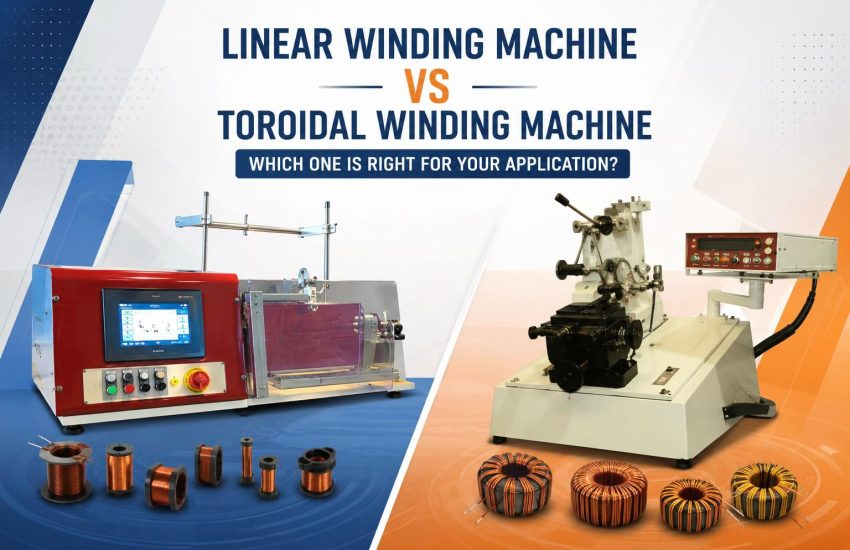
 Selecting the right winding machine is essential for manufacturers aiming to improve productivity, maintain consistent quality, and reduce operational costs. Two of the most widely used industrial winding solutions are the Linear Winding Machine and the Toroidal Winding Machine. Although both are designed to wind wire accurately, they serve different manufacturing purposes and are built for different types of components.
Understanding the difference between a Linear Winding Machine vs Toroidal Winding Machine can help businesses invest in equipment that aligns with their production goals. In this guide, we’ll compare their working principles, applications, advantages, limitations, and the industries that benefit most from each machine.
What is a Linear Winding Machine?
A Linear Winding Machine is designed to wind wire in a straight-line motion onto cylindrical, bobbin, or spool-shaped components. The wire guide moves linearly while the workpiece rotates, ensuring uniform wire placement and excellent winding precision.
These machines are commonly used in the manufacturing of transformers, relays, inductors, solenoids, motors, and various electronic components. Their flexibility allows manufacturers to produce a wide range of winding patterns while maintaining high production accuracy.
Key Benefits
- High winding accuracy
- Easy setup for different products
- Suitable for small and large production runs
- Consistent wire tension
- Supports automation for increased productivity
What is a Toroidal Winding Machine?
A Toroidal Winding Machine is specifically designed to wind wire around ring-shaped (toroidal) cores. Unlike linear machines, the wire passes through the center of the core repeatedly, producing highly compact and uniform windings.
Toroidal winding machines are widely used in electrical transformer manufacturing because toroidal transformers provide better efficiency, reduced electromagnetic interference, and lower energy losses.
Key Benefits
- Excellent winding consistency
- Reduced material wastage
- High-speed production
- Compact winding structure
- Ideal for high-efficiency transformers
Linear Winding Machine vs Toroidal Winding Machine
| Feature | Linear Winding Machine | Toroidal Winding Machine |
| Winding Method | Straight-line winding | Circular winding around toroidal cores |
| Core Shape | Cylindrical or bobbin | Ring-shaped cores |
| Applications | Motors, coils, relays, inductors | Toroidal transformers, inductors |
| Automation | High | High |
| Flexibility | Suitable for multiple products | Specialized applications |
| Production Speed | High | Very High |
| Precision | Excellent | Excellent |
| Maintenance | Easy | Moderate |
Applications of Linear Winding Machines
Linear Winding Machines are ideal for:
- Transformer coils
- Motor coils
- Solenoids
- Relay coils
- Sensor coils
- Automotive electrical components
- Industrial electronics
- Medical equipment
Their versatility makes them a preferred choice for manufacturers handling multiple product lines.
Applications of Toroidal Winding Machines
Toroidal Winding Machines are widely used in:
- Toroidal transformers
- Power supplies
- UPS systems
- Renewable energy equipment
- EV charging systems
- Industrial control panels
- Medical electronics
- Aerospace electrical systems
Because toroidal transformers are compact and energy-efficient, these machines are increasingly used in industries demanding high-performance electrical components.
Advantages of Linear Winding Machines
- Flexible for different winding applications
- Faster changeovers
- Easy programming
- Suitable for custom manufacturing
- Lower maintenance costs
- Supports complex winding patterns
- Excellent repeatability
Advantages of Toroidal Winding Machines
- Compact winding design
- Improved transformer efficiency
- Reduced electromagnetic interference
- Better copper utilization
- High-speed automated production
- Lower operational noise
- Excellent product consistency
Which Machine Offers Better Productivity?
The answer depends entirely on your manufacturing requirements.
If your business produces multiple types of electrical components, a Linear Winding Machine offers greater flexibility and quicker product changeovers.
However, if your production is focused on toroidal transformers, a Toroidal Winding Machine provides unmatched speed, efficiency, and winding precision.
For manufacturers with specialized transformer production, investing in a dedicated toroidal solution often results in higher long-term productivity and lower operating costs.
How to Choose Between a Linear Winding Machine and a Toroidal Winding Machine
Choosing the right winding machine depends on your production goals, product type, and manufacturing requirements. Consider the following factors before making an investment:
Product Design
If you’re manufacturing cylindrical coils, solenoids, relays, or motor coils, a Linear Winding Machine is the ideal solution. For ring-shaped transformer cores, a Toroidal Winding Machine is specifically engineered to deliver precise and efficient winding.
Production Volume
Manufacturers producing a variety of products in medium to high volumes benefit from the flexibility of Linear Winding Machines. On the other hand, Toroidal Winding Machines excel in dedicated, high-volume transformer production where speed and consistency are critical.
Automation Requirements
Both machines can be integrated into automated production lines. However, toroidal winding systems are often optimized for repetitive, high-speed manufacturing, while linear winding machines provide greater versatility for custom applications.
Budget Considerations
Linear Winding Machines are generally more adaptable across multiple industries, offering excellent long-term value. Toroidal Winding Machines are a worthwhile investment when your business specializes in toroidal transformer manufacturing.
Cost Comparison
While the purchase price varies depending on customization, automation level, and production capacity, businesses should evaluate the total cost of ownership rather than the initial investment alone.
Factors affecting the overall cost include:
- Machine automation level
- Production speed
- Maintenance requirements
- Energy consumption
- Product changeover time
- Labor costs
- Production efficiency
A machine that improves productivity and reduces downtime often delivers a higher return on investment over time.
Future Trends in Winding Machine Technology
The winding industry continues to evolve with advancements in automation and smart manufacturing. Modern winding machines now incorporate technologies that improve precision, reduce waste, and enhance operational efficiency.
Key trends include:
- CNC-controlled winding systems
- IoT-enabled machine monitoring
- Predictive maintenance
- AI-assisted quality inspection
- Automated wire tension control
- Industry 4.0 integration
- Energy-efficient manufacturing processes
Investing in advanced winding equipment helps manufacturers remain competitive while meeting growing production demands.
When comparing a Linear Winding Machine vs Toroidal Winding Machine, there is no one-size-fits-all solution. The right choice depends on the products you manufacture, your production volume, and your business objectives.
If your operations require flexibility across multiple winding applications, a Linear Winding Machine is an excellent option. If your focus is on manufacturing high-efficiency toroidal transformers, a Toroidal Winding Machine offers specialized performance, faster production, and exceptional winding quality.
Partnering with an experienced winding machine manufacturer ensures you receive equipment tailored to your production needs, helping improve efficiency, product quality, and long-term profitability.
Frequently Asked Questions
1. What is the difference between a Linear Winding Machine and a Toroidal Winding Machine?
A Linear Winding Machine winds wire onto straight or cylindrical components, while a Toroidal Winding Machine is specifically designed to wind wire around ring-shaped (toroidal) cores.
2. Which machine is better for transformer manufacturing?
For toroidal transformers, a Toroidal Winding Machine is the preferred choice. For conventional transformer coils and other electrical components, a Linear Winding Machine is often more suitable.
3. Can a Linear Winding Machine produce toroidal transformers?
No. Linear Winding Machines are not designed for toroidal cores. Specialized Toroidal Winding Machines are required for accurate winding of ring-shaped transformers.
4. Which winding machine offers higher production speed?
Both machines offer high productivity, but Toroidal Winding Machines are generally faster for dedicated toroidal transformer production, while Linear Winding Machines provide greater flexibility for multiple applications.
5. Which industries use Linear and Toroidal Winding Machines?
These machines are widely used in transformer manufacturing, electric motors, automotive electronics, industrial automation, renewable energy, medical devices, aerospace, telecommunications, and power electronics.
6. How do I choose the right winding machine for my business?
Consider your product type, production volume, automation needs, budget, and future expansion plans. Consulting an experienced winding machine manufacturer can help you select the most suitable solution.