

 Posted by
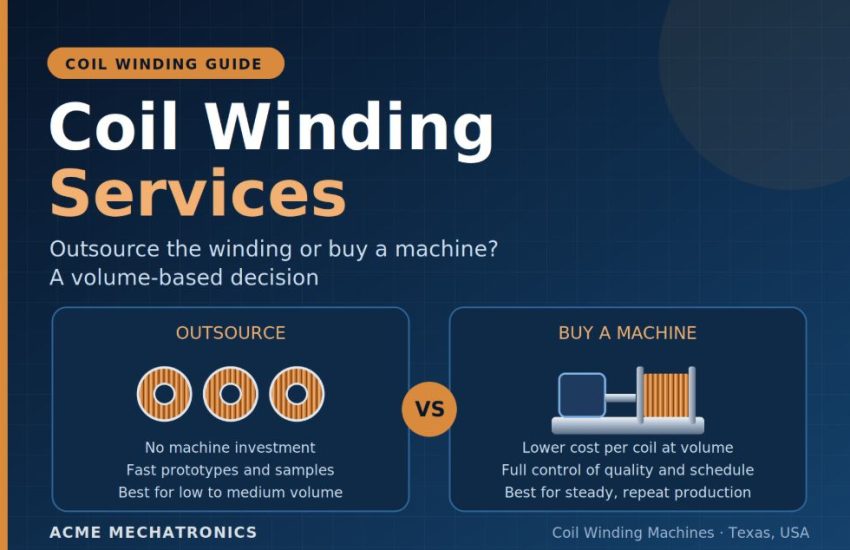
Every company that uses coils eventually faces the same question: should we outsource the winding, or bring it in-house with our own machine? The answer depends mostly on volume, but also on lead time, quality control, and how often your coil designs change.
This guide compares coil winding services with buying a machine, gives you a simple break-even method, and lists what to prepare before you ask for a quote.
What Are Coil Winding Services?
Coil winding services mean a specialist winds your coils for you. You supply the specification, and the provider supplies finished coils. There is no machine to buy, no operator to train, and no setup time on your side.
ACME Mechatronics offers coil winding services alongside its machines, so customers can start with winding done for them and move in-house later if volume grows.
When Outsourcing Coil Winding Makes Sense
- Prototypes and samples: You need a few coils quickly to test a design.
- Low volume coil winding: Your yearly quantity is too small to justify a machine.
- Changing designs: Specifications change often, and you do not want to tie up capital.
- Limited floor space or staff: You have no room or operators for a winding station.
- Testing before investing: You want to prove demand before buying equipment.
When Buying a Winding Machine Makes Sense
- Steady, repeat demand: You wind the same or similar coils every month.
- Higher volume: The cost per coil falls as you wind more in-house.
- Control over quality and schedule: You decide priorities instead of waiting in a queue.
- Protecting designs: Your coil design stays within your own walls.
- Faster turnaround: You can wind on demand, with no shipping time.
Outsourcing vs In-House: Side-by-Side
| Factor | Coil Winding Services | Own Winding Machine |
|---|---|---|
| Upfront cost | None | Machine, tooling, and setup |
| Cost per coil | Price per coil, steady | Falls as volume grows |
| Lead time | Depends on provider schedule and shipping | As fast as you can wind |
| Quality control | Agreed with the provider | Fully in your hands |
| Flexibility | High; easy to change designs | High once set up, but needs operator skill |
| Staffing | No winding staff needed | Operator and training needed |
| Best for | Prototypes, low to medium volume | Steady, repeat, higher volume |
How to Calculate Your Break-Even Point
A simple formula shows when buying a machine starts to pay off:
Break-even quantity = total upfront cost ÷ (outsourced price per coil − in-house cost per coil)
Total upfront cost includes the machine, tooling, accessories, setup, and operator training. In-house cost per coil includes wire, labour, power, scrap, and maintenance.
Illustrative example (made-up numbers, not ACME pricing): if all upfront costs total $15,000, outsourcing costs $4.00 per coil, and winding in-house costs $1.50 per coil, then the break-even quantity is $15,000 ÷ $2.50 = 6,000 coils. If you expect to wind well over 6,000 coils, buying becomes attractive. If you expect far fewer, outsourcing is usually cheaper.
Run the same calculation with your own figures. Also consider the value of faster turnaround and design privacy, which the formula does not capture.
Hidden Costs to Watch For
Both options carry costs that do not appear on the first quote. Account for them before you decide.
Hidden costs of outsourcing
- Shipping and import or export charges, especially for urgent orders.
- Minimum order quantities or setup fees on small runs.
- Delays if the provider’s schedule is full when you need coils.
- Time spent on communication, revisions, and incoming inspection.
Hidden costs of buying a machine
- Operator training and the learning curve before coils are consistently good.
- Tooling, bobbins, and accessories for each coil design.
- Floor space, power, and maintenance over the life of the machine.
- Scrap while you tune the process for new coils.
A Hybrid Approach: Start with Services, Move In-House Later
Many buyers do not have to choose once and forever. A common path is to outsource prototypes and early production, learn the coil’s real requirements, then buy a machine when volume is stable. This lowers risk because you buy equipment only after demand is proven.
Quality, Lead Time and Design Protection
Three factors often decide the question when cost is close.
Quality control. With in-house winding you inspect every batch yourself and fix problems the same day. With a service provider, agree on tolerances, test methods, and inspection reports up front so there are no surprises.
Lead time. Outsourcing adds shipping and queue time. In-house winding lets you react to urgent orders at once, but only if a trained operator is available.
Design protection. If your coil design is proprietary, consider who sees the drawings. Ask any provider about confidentiality before you share specifications.
Questions to Ask a Coil Winding Service Provider
- What coil sizes, wire gauges, and winding types can you handle?
- What is your typical lead time for prototypes and for production runs?
- How do you inspect and test finished coils, and can you share test results?
- What are your minimum order quantities and setup charges?
- How do you protect confidential designs?
- Can you scale up or help me move winding in-house later?
What to Prepare Before Requesting a Quote
- Coil drawing or specification, including dimensions and bobbin or core details.
- Wire type and gauge, and any insulation requirements.
- Number of turns, layers, and winding direction.
- Tolerances and any test requirements.
- Expected quantity per order and per year.
- Delivery timeline and packaging needs.
Coil Winding Services and Machines from ACME Mechatronics
ACME Mechatronics, based in Northlake, Texas, is a manufacturer, supplier, and exporter of coil winding machines, with standard models and custom-built winding machines for specific coils. See our full range of coil winding machines, read what our clients say, or learn about our global exports.
Not sure whether to outsource or buy? Send us your coil details and expected volume, and ask about a machine demonstration and sample winding through our contact page. You can also check our FAQ for common questions.
Request a quote for coil winding services
FAQs
What are coil winding services?
Coil winding services are provided by a specialist who winds coils to your specification and delivers finished parts, so you do not need your own winding machine.
Is it cheaper to outsource coil winding or buy a machine?
For low volumes, outsourcing is usually cheaper because there is no upfront investment. For steady, higher volumes, an in-house machine usually costs less per coil. A break-even calculation with your own numbers gives the answer.
Can I get custom coil winding services in the USA?
Yes. ACME Mechatronics offers coil winding services from its facility in Northlake, Texas, and also supplies machines if you later decide to wind in-house.
What volume counts as low volume coil winding?
There is no fixed number. As a rule of thumb, if your yearly quantity is below your break-even point, outsourcing is likely the better fit.
Can I buy a machine after trying coil winding services?
Yes. Many customers start with services to prove demand and then move to an in-house machine once volume is steady.