

 Posted by
Choosing a coil winder is rarely about the machine alone. It is about how the machine is controlled. Two common designs sit side by side on the market: winders built around a dedicated embedded controller, and winders built around a PLC with servo motors. Both wind good coils, but they suit different jobs.
This guide explains how a servo coil winding machine differs from an embedded-controller winder, so you can match the machine to your coils, your volume, and your budget.
What Is an Embedded-Controller Coil Winder?
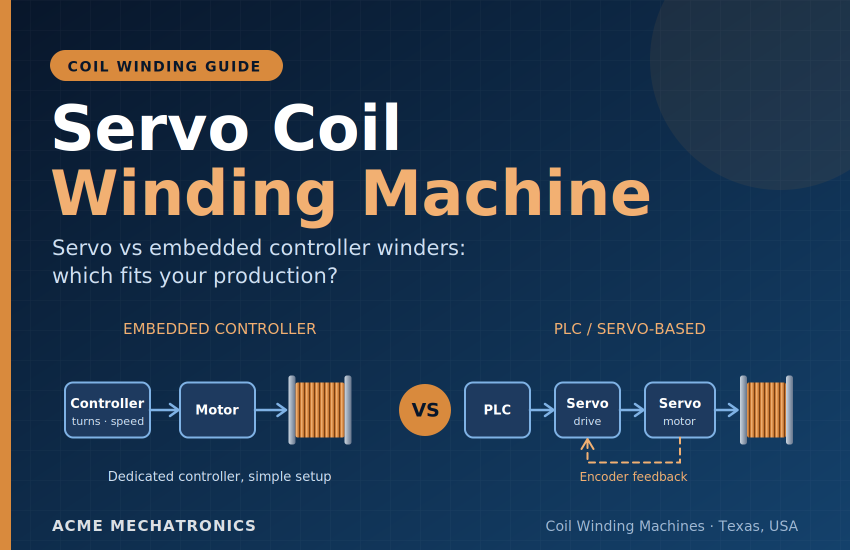
An embedded-controller winder uses a dedicated electronic controller built for one job: winding coils. The operator enters the basics (turns, wire diameter, bobbin width, speed, and layers) on a simple keypad or display, and the machine handles the rest.
This design keeps setup quick and the learning curve short. It is the approach used in our embedded AE series winders, which are popular for transformers, solenoids, inductors, and general-purpose coils.
What Is a PLC and Servo-Based Coil Winding Machine?
A PLC coil winding machine uses a programmable logic controller to coordinate the motion axes. In a servo-based design, servo motors drive the spindle and the wire traverse. Each servo reports its position back to the drive through an encoder, so the controller knows where every axis is and corrects any error as it winds.
This closed-loop feedback is what gives a servo coil winding machine its precision and flexibility. Our PLC / servo-based linear winding machine range is built on this approach.
Servo vs Embedded Controller: Side-by-Side Comparison
| Factor | Embedded Controller Winder | PLC / Servo-Based Winder |
|---|---|---|
| Control architecture | Dedicated winding controller | PLC or motion controller with servo drives |
| Motion feedback | Typically simpler motor control | Closed-loop encoder feedback |
| Programming | Enter winding parameters on a keypad or display | Programmable sequences and custom winding profiles |
| Flexibility | Best for standard winding patterns | Handles complex patterns and multi-step processes |
| Integration | Usually stand-alone | Can connect to factory automation and data systems |
| Setup and training | Quick to learn | Needs more programming knowledge |
| Upfront cost | Generally lower | Generally higher |
| Best for | Prototypes, small batches, general coils | Demanding coils, repeatable high-volume production |
When an Embedded-Controller Winder Is the Right Choice
- You wind standard coils such as transformers, inductors, and solenoids.
- You want a machine your operators can learn in a short time.
- Your production is prototype, small-batch, or low to medium volume.
- You want the lowest upfront cost without giving up winding quality.
- You do not need to link the machine to a wider automation system.
When a Servo-Based Winder Is the Right Choice
- Your coils need tight positional control, such as fine wire, close layer packing, or precise turn placement.
- You run complex winding patterns or multi-step recipes.
- You need to connect the winder to a production line, a PLC network, or a data-collection system.
- You expect to scale up to higher volumes or add more axes later.
- You make coils where scrap is expensive, so closed-loop accuracy pays for itself.
How Tension Control and Accessories Affect the Choice
The controller is only part of the story. Wire tension has a direct effect on coil quality, especially with fine wire. Whichever design you choose, pair it with the right winding machine tensioners and, where needed, other winding machine accessories such as wire guides and tooling.
Total Cost of Ownership: Look Beyond the Purchase Price
The price on the quote is only the start. The real cost of a winder includes everything it takes to keep good coils coming off the machine year after year. When you compare an embedded-controller winder with a servo-based one, weigh these items:
- Setup and programming time: How long does it take to load a new coil design and run the first good coil?
- Operator training: A simpler interface means faster training and fewer mistakes.
- Scrap and rework: Closed-loop control can cut scrap on demanding coils, which matters when wire or cores are expensive.
- Downtime and spares: Ask what parts wear out, how fast they ship, and how quickly support responds.
- Future flexibility: Think about whether your coil range will grow or stay the same.
For simple, repeat coils, an embedded-controller winder often has the lower total cost. For complex coils, frequent design changes, or tight tolerances, the extra investment in servo control can pay back through lower scrap and faster changeovers.
How to Choose: Questions to Ask Before You Buy
- What are you winding? List wire sizes, coil dimensions, and winding patterns.
- What volume do you expect? Think about this year and the next three years.
- Who will run the machine? Match the control complexity to your team’s skills.
- Do you need factory integration? If so, a PLC and servo design is worth considering.
- What is your quality target? Tighter tolerances favour closed-loop servo control.
- What support do you need? Ask about training, spare parts, and service response.
Common Mistakes to Avoid When Choosing a Coil Winder
- Buying more control than you need: Extra features add cost and complexity if your coils are simple.
- Buying too little for future needs: A machine that cannot handle your next product line forces another purchase soon.
- Ignoring wire tension: Even the best controller cannot fix poor tension on fine wire.
- Skipping a sample run: Always wind a trial coil before you commit. Ask the supplier about a sample winding or demonstration.
- Forgetting support: A winder is only as good as the training, spares, and service behind it.
Find the Right Winder with ACME Mechatronics
ACME Mechatronics, based in Northlake, Texas, supplies standard and custom-built coil winding machines. If you are unsure whether an embedded or servo-based design suits your coils, share your wire size, coil dimensions, and daily output, and we will recommend a configuration.
Browse our full range of linear winding machines, or contact our team to discuss your application.
Talk to ACME Mechatronics about your winding application
FAQs
What is a servo coil winding machine?
It is a coil winder that uses servo motors with encoder feedback to control the spindle and wire traverse. The feedback lets the machine place wire accurately and correct errors while winding.
Is a PLC coil winding machine better than an embedded winder?
Not always. A PLC and servo design offers more flexibility and integration, while an embedded-controller winder is simpler, quicker to set up, and often lower in cost. The better choice depends on your coils and volume.
Can an embedded-controller winder wind precision coils?
Yes. Embedded winders handle a wide range of coils well, including transformers, solenoids, and inductors. Servo control becomes more valuable when coils are complex or tolerances are very tight.
Do I need a programmable coil winding machine for small batches?
Often not. Many small-batch jobs run well on a simple embedded-controller winder with stored winding programs. A more programmable machine helps when you switch between many coil designs or need automation links.
Where can I buy a programmable coil winding machine in the USA?
ACME Mechatronics supplies programmable coil winding machines from its facility in Northlake, Texas, and ships to customers in the USA and worldwide.